
 Send Inquiry


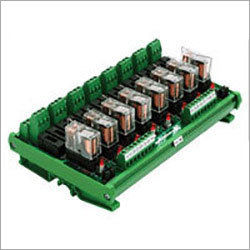
TTPL Relay Modules
45 INR/Unit
Product Details:
- Connector Type Pluggable Connector
- Mounting Type DIN Rail Mounting
- Shape Rectangular
- Operating Temperature -20 C to 70 C Celsius (oC)
- IP Rating IP40
- Surface Finish Green Plastic Coating
- Overheating Protection YES
- Click to View more
X
TTPL Relay Modules Price And Quantity
- 1000 , , Piece
- 45 INR/Unit
TTPL Relay Modules Product Specifications
- Single Pole
- Relay Output
- Relay Modules
- Plastic
- YES
- Industrial Automation
- Green Plastic Coating
- High
- Plastic and Metal
- DIN Rail Mounting
- Pluggable Connector
- Single Phase
- Pluggable Relay Modules
- 250V AC Volt (V)
- Screw Terminals
- 24V DC Volt (V)
- Compact
- -20 C to 70 C Celsius (oC)
- Other
- Rectangular
- IP40
- Green
- 1 Year
Product Description
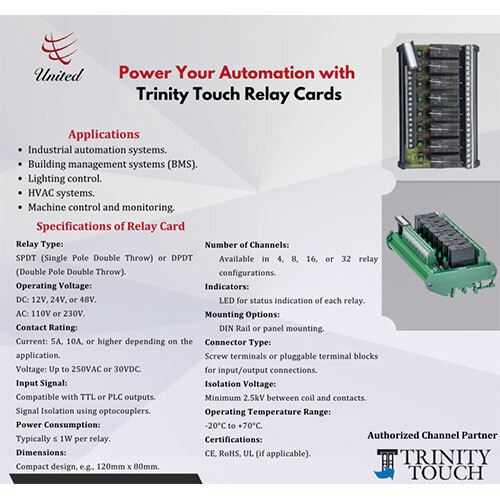
Trinity Touch Relay Card is a pre-assembled, multi-channel PLC interface module designed to simplify and speed up wiring between PLC outputs and field devices. Commonly used as a relay board, it integrates 4, 8, or 16 relays on a single DIN-rail mountable module, helping reduce panel space, wiring complexity, and installation time.
These relay cards are widely used in industrial automation control panels where multiple PLC digital outputs need reliable electrical isolation and signal amplification to operate high-load devices such as contactors, solenoid valves, motors, and alarms. Robust screw terminals ensure secure field connections, while optional Flat Ribbon Cable (FRC) connectors on the PLC side allow quick plug-and-play installation.
Available Variants
-
8-Channel Relay Card Ideal for standard PLC output interfacing
-
4-Channel Relay Card Suitable for compact control systems
-
16-Channel Relay Card High-density solution for large I/O applications
Technical Specifications (Typical 8 Channel)
-
Input Coil Voltage: 24V DC
-
Output Contact: 1 Changeover (SPDT) per channel
-
Switching Current: 5A to 10A per channel (model dependent)
-
Switching Voltage: Up to 250V AC/DC
-
Protection: Built-in freewheeling diode for PLC output protection
-
Indication: Individual LED status indication for each channel
-
Mounting: DIN Rail (NS 35)
-
Connections: Screw terminals (field side) / FRC or screw connector (PLC side)
Key Advantages
-
Reduces panel wiring and installation time
-
Provides reliable isolation between PLC and field loads
-
Compact and space-saving design
-
Easy troubleshooting with LED indication
-
Suitable for continuous industrial operation
Applications
-
PLC output interfacing
-
Pneumatic solenoid valve control
-
Motor and contactor switching
-
Industrial automation panels
-
Power and process control systems
High-Performance Design for Industrial Automation
Engineered specifically for industrial automation tasks, TTPL Relay Modules deliver dependable switching with their advanced relay output and high power factor. Compact in size and constructed with a durable plastic and metal blend, these modules withstand challenging operating temperatures and offer excellent insulation, ensuring longevity and stable performance.
Convenient and Secure Installation
Installation is simplified with screw terminals and pluggable connectors, making the modules easy to connect and replace. The DIN rail mounting system adds to their convenience, allowing for quick setup and modification in industrial control panels or automation circuits.
FAQ's of TTPL Relay Modules:
Q: How do I install the TTPL Relay Module in an industrial control panel?
A: Install the TTPL Relay Module by securing it onto a DIN rail using the built-in mounting clips. Connect power and load wires to the screw terminals and secure the pluggable connector to ensure optimal electrical contact. The compact design allows easy integration into limited space environments.Q: What are the primary benefits of the green plastic coating surface finish?
A: The green plastic coating provides enhanced insulation, improved resistance to environmental contaminants, and increased durability, while also making the module easily identifiable within control enclosures.Q: When should I choose a single-pole, single-phase relay like this TTPL module?
A: Single-pole, single-phase relays are ideal for applications requiring the switching of one circuit, especially in industrial automation systems where precise control of AC loads (up to 250V) is necessary.Q: Where can these relay modules be used most effectively?
A: TTPL Relay Modules are best suited for industrial automation setups, factory process controls, machine automation panels, and other environments where compact, reliable relay switching is needed.Q: What protective features does the relay module offer against overheating?
A: This relay module is equipped with an overheating protection system to prevent damage from excessive temperatures, ensuring reliable operation within the recommended -20C to 70C range.Q: How does the pluggable relay module design enhance maintenance or upgrades?
A: The pluggable design allows quick replacement or upgrading of the relay module without the need to rewire or remove the entire setup, minimizing downtime in industrial operations.Tell us about your requirement

Price:
Quantity
Select Unit
- 50
- 100
- 200
- 250
- 500
- 1000+
Additional detail
Mobile number
Email

Other Products in 'TTPL Electrical Components' category

Contact Details
UNITED CONTROL ENGINEERS INDIA PRIVATE LIMITED
GST : 09AACCU4195M1ZP
GST : 09AACCU4195M1ZP

- Plot No. 98, Toy City, Ecotech-3rd, Greater Noida - 201306, Uttar Pradesh, India
- Phone :08071793171
- Mr Sumit Agrawal (Director)
Mr. Pramendra Chaudhary (Director)
Mobile :+919311150492, +919990632600, +919999706958 -
 marketing@unitedcontrolengg.com
 Send Inquiry
 Send SMS

|
UNITED CONTROL ENGINEERS INDIA PRIVATE LIMITED
All Rights Reserved.(Terms of Use)
Developed and Managed by Infocom Network Private Limited.
Developed and Managed by Infocom Network Private Limited.

