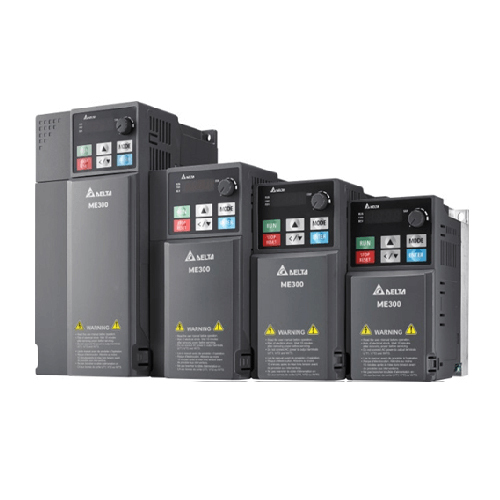
Applications
Fans & pumps, conveyors, blowing machines, packing machines, wood working machines
Features:
- Supports IM / IPM /SPM motors and VF / SVC control
- Dual rating design:
-Normal Duty (ND), 120% for 60 seconds or 150% for 3 seconds
-Heavy Duty (HD), 150% for 60 seconds or 200% for 3 seconds - Up to 200% rated starting torque at 3 Hz
- 2 set of motor parameter for multi-motor control
- Supports high speed pulse and PWM signal input
- Built-in single /multi-pump function
- Built-in braking choppers for the entire series
- Optional EMC filter for 1-phase 230V(C2), 3-phase 460V(C3) models
- Optional Safe Torque Off (SIL2/PLd) model
- 100% PCB coating for circuit(IEC 60721-3-3 class 3C3) for harsh environment.
Range: Single Phase – 0.5HP to 3HP
Range: Three Phase – 0.5HP to 10HP
Advanced Control Methods for Precise PerformanceLeverage V/F and Sensorless Vector control, allowing for fine-tuned speed and torque regulation. Achieve high starting torque-up to 150% at 1 Hz-for heavy-duty applications. The ME300 Series supports digital and analog outputs, ensuring compatibility and flexibility across diverse automation setups.
Streamlined Operation and User-Friendly ProgrammingThe LED Digital Display and multi-mode programming (keypad, remote, PC software) deliver operational convenience. Set up and monitor performance, modify parameters, and receive real-time fault, overload, or overheat indications, ensuring seamless and safe usage even in critical environments.
Engineered for Reliability and SafetyWith a built-in braking unit, C2 EMC filter, and comprehensive protection mechanisms (over-voltage, under-voltage, over-current, short-circuit), the ME300 Series VFD ensures long-term stability and equipment safety. High efficiency up to 98%, along with a robust IP20 enclosure, delivers worry-free performance in temperatures from -10C to +50C.
FAQ's of ME300 Series VFD:
Q: How do I connect and program the ME300 Series VFD for my industrial motor?
A: You can connect the ME300 Series VFD using the standard terminal block with screw terminals for three-phase power input and motor output. Programming is straightforward, thanks to the LED Digital Display and options for keypad, remote, or PC software setup. Follow the manual to assign parameters based on your motor type and application.
Q: What motors are compatible with this VFD, and what is its power range?
A: The ME300 Series is engineered for both induction and synchronous motors, supporting loads between 0.75 kW and 22 kW. It is ideal for applications ranging from pumps and conveyors to HVAC systems in industrial automation.
Q: When should I use sensorless vector control instead of V/F mode?
A: Opt for sensorless vector control when precise torque and speed regulation are essential, such as during high starting load or demanding process control. Use V/F mode for simpler, less critical variable speed applications.
Q: Where can I install the ME300 Series VFD, and what are its environmental limits?
A: This VFD supports wall or panel mounting. It operates reliably at altitudes up to 1000 meters without derating, within a temperature range of -10C to +50C, and in humidities from 5% to 95% non-condensing.
Q: What process alarms and protections are built into the device?
A: The ME300 Series features fault, overload, and overheat alarms, plus protections against over-voltage, under-voltage, over-current, and short-circuits. The built-in thermal protection helps prevent overheating damage, increasing reliability and safety.
Q: How does the built-in braking unit and EMC filter benefit my system?
A: The integrated braking unit improves dynamic stopping performance, while the C2 EMC filter reduces electrical noise, enhancing compliance and operational stability-ideal for sensitive or regulated environments.
Q: What are the main benefits of choosing the ME300 Series VFD for my application?
A: You gain high efficiency (up to 98%), customizable parameters, silent operation, compact design, reliable protection features, and advanced communication (Modbus via RS485). These collectively boost system performance, safety, and operational cost-effectiveness.