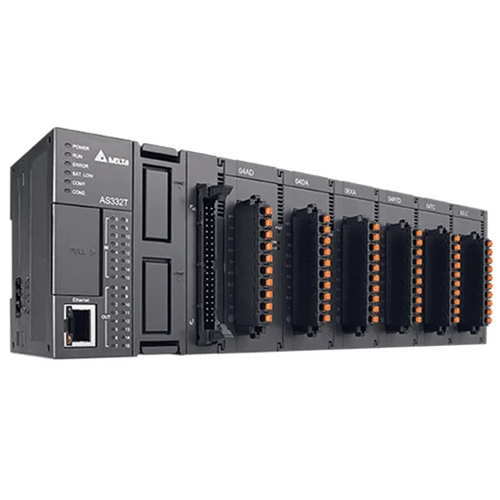
Applications: Automated equipment such as electronics manufacturing, labeling, food packaging, and textile machines
Specifications:
- New 32-bit SoC (System on Chip) CPU
- I/O: 1,024
- Program capacity: AS300 series 128k steps, AS200 series 64k steps
- Data registers: 60k words
- Extension modules: max. 32 (analog modules: max.16 / communication modules: max. 4)
- Execution speed: up to 40 k steps / ms
- Basic instruction (LD): 25 ns
- Application instruction (MOV): 0.15 μs
- Abundant selection of DIO modules, AIO modules, temperature modules, load cell module and function cards
Flexible Communication and ExpansionWith RS232 and RS485 communication ports, the AS Series PLC facilitates seamless integration with other devices and networks. The controller also allows for expansion up to 512 I/O points, ensuring adaptability as system requirements grow. This flexibility supports applications from small machines to large automation lines in various industrial settings.
Advanced Diagnostics and User-Friendly InterfaceThe PLC features a self-diagnosis function and LED indicators for easy status monitoring and troubleshooting. Ladder Diagram and Function Block Diagram (FBD) programming languages are supported, simplifying development and reducing setup time for technicians and engineers, helping to minimize downtime during installation and maintenance.
Rugged Build and High PerformanceConstructed from ABS plastic with a polycarbonate insulation, the PLC is engineered to withstand harsh environments. It operates efficiently in temperatures ranging from 0C to 55C and offers vibration resistance, a response time of 0.1 ms, and high accuracy even under demanding industrial conditions. The built-in power supply and IP20 protection ensure reliable long-term performance.
FAQ's of PLC AS Series:
Q: How can the PLC AS Series be integrated into an existing industrial automation system?
A: Integration is straightforward thanks to its RS232 and RS485 communication ports, enabling interface with a variety of industrial devices. Its screw terminal connection type and DIN rail mounting make physical installation and wiring simple within standard control panels.
Q: What programming methods are supported for developing automation routines?
A: The PLC AS Series supports both Ladder Diagram (LD) and Function Block Diagram (FBD) programming, allowing technicians to choose the most suitable language for their application's complexity and requirements.
Q: When should I consider expanding the I/O capability of the PLC?
A: You should consider expanding the I/O points when your system requires more than the standard 8 digital inputs and 8 digital outputs provided. The expansion option enables scaling up to 512 I/O points to accommodate growing automation demands or additional sensors and actuators.
Q: Where is the best application context for using the PLC AS Series in India?
A: This PLC is ideal for industrial automation across multiple sectors including manufacturing, process control, and machinery in India. Its robust design and industry-standard connectivity make it suitable for dealer, distributor, exporter, retailer, supplier, trader, and wholesaler environments.
Q: What process does the self-diagnosis function follow for error detection?
A: The self-diagnosis function continuously monitors internal circuits and component status. Should a malfunction occur, the PLC activates the corresponding LED indicator and can output diagnostic information, helping maintenance personnel identify and address issues promptly.
Q: How does the PLC AS Series enhance operational efficiency and safety?
A: High-speed processing (0.1 ms response time), overheating protection, and a compact, durable design ensure reliable and efficient operation. IP20 protection and high humidity tolerance further contribute to safe use in demanding industrial environments.
Q: What are the energy consumption and power characteristics of the PLC?
A: The PLC operates at 220 V AC with a built-in power supply, ensuring compatibility with standard industrial mains. Its low energy consumption and 0.93 power factor deliver efficient performance while reducing operational costs.